What your gadgets really cost sitting idle
The standby light on the television is capped by law at half a watt. The router sitting beside it is allowed sixteen times that, and unlike the television it never switches off. Almost everything worth knowing about phantom load is contained in that asymmetry.
"Vampire power" is one of the oldest pieces of energy advice in circulation, and it has aged badly in one specific way. The advice was written for a world in which a video recorder drew five watts doing nothing and a mobile phone charger stayed warm to the touch all day with no phone on it. That world was legislated out of existence, in stages, over about fifteen years.
What replaced it is less intuitive. Most devices in a home now sip a fraction of a watt when switched off — genuinely too little to care about. A handful draw ten or twenty times more, because they are holding a network connection open, and those are precisely the ones nobody thinks to unplug. This guide sets out the legal ceilings, what a watt of continuous draw costs over a year at today's prices, and how to find a device's figure without a meter.
On this page
The short answer
- Off mode and simple standby are capped at 0.5 W across most household and office equipment sold in the EU, falling to 0.3 W for off mode from 9 May 2027 under Regulation (EU) 2023/826. Standby with a clock or status display gets 0.8 W.
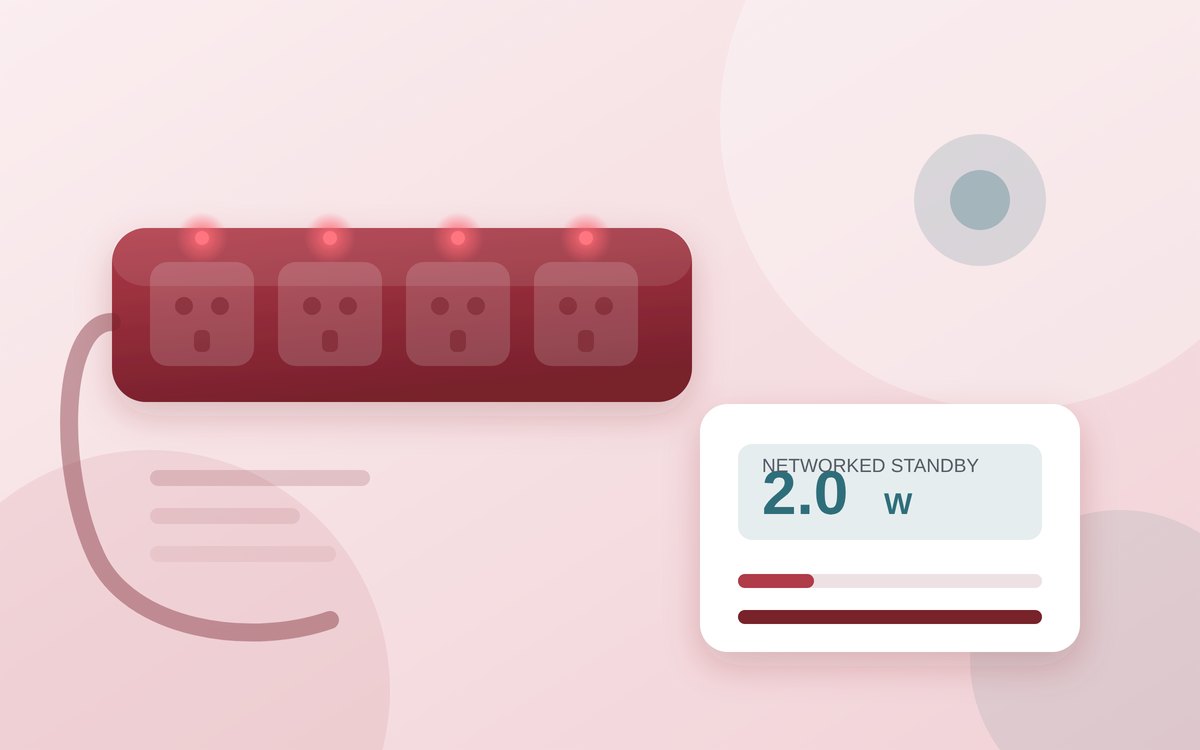
- Networked standby is the expensive category. A device that stays reachable over the network is allowed 2 W — and equipment whose whole job is networking (routers, modems, switches, access points) is allowed 8 W, dropping to 7 W in 2027.
- One watt of continuous draw is 8.76 kWh a year. At the EU average household price for the second half of 2025, €0.2896 per kWh, that is about €2.54 a year; at the Great Britain price cap rate for October to December 2026, 26.32p per kWh, about £2.31.
- The Commission's own figure for the whole category is around 40 TWh a year across roughly 4 billion products in the EU27, with existing rules already saving users an estimated €5.8 billion in 2020.
- You should not need a meter. The regulation obliges manufacturers to publish the wattage of every low-power mode, to one decimal place, in the instructions and on a freely accessible website.
- Televisions, monitors and computers are governed elsewhere, under separate ecodesign regulations with their own — in some cases higher — ceilings.
Three modes, three legal ceilings
The regulation's usefulness comes from the fact that it defines its terms precisely, which marketing copy does not. Three states matter.
Off mode means the equipment is connected to the mains and providing no function at all, beyond possibly an indicator that it is off and whatever circuitry electromagnetic compatibility requires. This is the state of a printer you have switched off at its own button.
Standby mode means it is providing only the ability to be reactivated — by a remote control, an internal sensor, a timer — plus optionally an indicator or a display of status information, held indefinitely. The microwave showing 00:00 is in standby.
Networked standby means the equipment is maintaining a network connection so that it can be woken by a signal arriving from somewhere else. That extra capability is why the ceiling is four times higher, and why it applies to a growing share of the things in a house.
"HiNA" is the regulation's term for high network availability equipment, and it is defined by function rather than by marketing category: a device whose only main functions are those of "a router, network switch, wireless network access point, hub, modem, VoIP telephone, video phone". Those devices get the 8 W allowance because they are expected to be awake and forwarding traffic continuously. It is a sensible concession, and it is also the single largest permitted idle load in a normal home.
Two other requirements in the same regulation matter as much as the headline numbers. Equipment must drop into a low-power mode on its own after "the shortest period of time appropriate for the intended use" — a hard maximum of 20 minutes for most products. And any networked device that can use a wireless connection must give the user a way to switch that connection off.
Keep reading
The products the rules don't cover
Regulation 2023/826 is a horizontal measure: it sets standby rules across many product types at once. Where a product has its own dedicated ecodesign regulation, that one takes precedence, and the ceilings are not always the same. Three carve-outs are worth knowing about.
| Product | Governed by | Low-power ceilings |
|---|---|---|
| Televisions, monitors and other electronic displays | Regulation (EU) 2019/2021 | 0.3 W off, 0.5 W standby, 2.0 W networked standby — plus allowances of up to +0.2 W for a status display, +0.5 W for presence detection, +1.0 W for touch, and +4.0 W for a HiNA function |
| Desktop and notebook computers | Regulation (EU) No 617/2013 | Its own sleep, off and idle requirements, tied to the machine's class |
| Servers and data storage products | Regulation (EU) 2019/424 | Separate idle-state and efficiency requirements |
| Washing machines, dishwashers and similar | Product-specific regulations | Removed from the horizontal standby rules in favour of their own |
The display figures repay a second look. A large television with a status LED, room-presence detection and a built-in network function can legally sit in networked standby at 7.7 W, more than the 2 W the same table would suggest at a glance. That is the same reasoning that makes the energy figures on a spec sheet hard to compare across categories, a problem we looked at in the context of the energy label on phones.
One more asymmetry: Great Britain has not adopted 2023/826. The retained version of the older Regulation (EC) No 1275/2008 still applies there, and its final stage — in force since 1 January 2019 — caps non-HiNA networked standby at 2 W and HiNA at 8 W, with 0.5 W for off mode and simple standby and 1.0 W for standby with a display. In practice that means the current ceilings are close to identical on both sides of the Channel; the divergence starts in May 2027, when the EU figures tighten and the retained ones do not.
What a watt costs over a year
The arithmetic is the least interesting part of this subject and the part people most often get wrong, so here it is plainly. A device drawing one watt continuously uses 8.76 kWh over a 365-day year — 1 W × 8,760 hours. Everything else is multiplication.
| Continuous draw | Per year | At €0.2896/kWh (EU average, H2 2025) | At 26.32p/kWh (GB price cap, Q4 2026) |
|---|---|---|---|
| 0.3 W — off mode from 2027 | 2.6 kWh | €0.76 | £0.69 |
| 0.5 W — off mode, simple standby | 4.4 kWh | €1.27 | £1.15 |
| 0.8 W — standby with a display | 7.0 kWh | €2.03 | £1.84 |
| 2.0 W — networked standby | 17.5 kWh | €5.07 | £4.61 |
| 7.7 W — display at its full allowance | 67.5 kWh | €19.53 | £17.75 |
| 8.0 W — HiNA networking kit | 70.1 kWh | €20.29 | £18.44 |
Read down that table and the practical conclusion assembles itself. Chasing a 0.5 W standby light is chasing roughly a pound a year. The router is a different order of magnitude, and so is a television that makes full use of its allowances. Prices vary enormously by country — Eurostat put Ireland highest in the second half of 2025 at €0.4042 per kWh and Hungary lowest at €0.1082 — so multiply the kilowatt-hours column by your own tariff rather than trusting either currency column.
A caveat on those bars: a ceiling is not a measurement. Manufacturers design to comfortably clear the limit, and Berkeley Lab's standby project notes that most products now draw "less than 0.5 watts" where twenty years ago 1–3 W was typical. Treat the table as an upper bound on what any single legally compliant device can be costing you.
Advertisement
Four billion devices, forty terawatt-hours
Individually trivial, collectively not. The European Commission's own product documentation for this regulation counts roughly 4 billion standby-capable products across the EU27, consuming about 40 TWh of electricity in 2020, and projects around 35 TWh in 2030 with the measures in place — a reduction it puts at about 52 % against a scenario with no rules at all. Regulation 2023/826 is credited with 4 TWh a year of that by 2030, and 1.36 Mt of CO2-equivalent.
On the household side, the Commission estimates EU27 users saved €5.8 billion on standby in 2020 thanks to the rules, rising to a projected €7.9 billion in 2030 — roughly €29 per household per year, or about eleven and a half watts of continuous draw eliminated per home. Berkeley Lab's standby project puts what remains at 5–10 % of residential electricity use. Both can be true at once: the per-device numbers have collapsed, and the number of devices has not.
Finding the number without a meter
This is the part most standby advice skips, and it is the easiest win. Annex III of Regulation 2023/826 requires manufacturers to state, in the instruction manual and on a freely accessible website:
- the power consumption in watts, rounded to one decimal place, in each applicable low-power mode;
- the time after which the equipment reaches that mode automatically, in minutes;
- the power consumption in networked standby with all network ports connected and all network functions activated — the worst case, not a favourable configuration;
- how to activate and deactivate wireless connections.
So the first move on any device is to search its model number plus "networked standby", or to open the manual's technical section — not to buy hardware. For anything sold in the EU since May 2025 the figure is supposed to be published, and where it is missing, that absence is itself informative.
The spread between compliant products can be large. iFixit's bench work, cited in our piece on Qi2 wireless charging, recorded an Apple MagSafe puck drawing about 0.2 W sitting empty against 1.4 W for a car-maker's wireless platform — sevenfold, between two devices doing nothing.
Measuring it yourself, and why it's harder than it looks
Circuitry does not operate a test bench, and the honest reason is visible in the measurement standard. IEC 62301, the international method that ecodesign compliance testing follows, is demanding about the conditions under which a sub-watt reading means anything:
- Instrument resolution of 0.01 W or better for readings below 10 W, and measurement uncertainty below 2 % at 95 % confidence for values above 0.5 W. Below 0.5 W, even the standard accepts a larger margin.
- Ambient conditions of 23 °C ± 5 °C in still air.
- A clean supply: total harmonic distortion no greater than 2 % through the 13th harmonic, and a voltage crest factor between 1.34 and 1.49. Mains in a flat is not that.
- Stability before reading: power varying by less than 5 % over five minutes. Where the load fluctuates — which describes most networked devices — you must instead accumulate energy over a period and divide by the time.
None of which makes a cheap plug-in monitor useless; it means knowing what it is good for. These meters are designed around loads of tens or hundreds of watts, so sub-watt readings sit at the very bottom of their range — and a low power factor, common in the small switch-mode supplies that produce standby draw, is exactly the condition that makes an inexpensive meter read badly. The workaround follows IEC 62301's own logic: ignore the instantaneous watts display, leave the device plugged in for a week, and read the accumulated kilowatt-hours instead. Better still, meter a group — the set, the soundbar, the streaming box and the console on one switched lead for a week with nobody using any of it. That total is the number a decision actually rests on.
What is actually worth switching off
Three tiers, in descending order of payoff.
Worth thinking about. Networking equipment and anything else permanently in networked standby, because 2 to 8 W continuous is where the real money sits. A router does need to stay on if a doorbell or a thermostat depends on it — but a mesh satellite in a spare room, an access point covering a garden nobody uses in winter, or a set-top box for a service you have stopped watching are pure overhead.
Worth doing once, then forgetting. Grouping the entertainment cluster onto one switched lead; turning off wireless radios on devices that are wired anyway, which the regulation obliges manufacturers to let you do; and checking that anything with an auto-off timer actually uses it. A desktop monitor is the classic case — the specs that matter there are covered in our monitor buying guide — and a display left showing a "no signal" message all night is not in any low-power mode at all.
Not worth your attention. Unplugging phone chargers with no phone attached: a compliant no-load charger draws hundredths of a watt, and the wear on the socket is the more realistic downside. Likewise the microwave clock, the oven display, the standby LED on a printer — each capped at 0.5 to 0.8 W, which is one to two pounds or euros a year against the nuisance of resetting clocks.
The reason the old advice feels wrong now is that it succeeded. Fifteen years of ratcheting ceilings turned standby from a real household expense into a rounding error for most devices — while quietly creating a new category, the always-connected box with an 8 W allowance, that the advice never mentions. That is where to look first, and the number you need is probably already published in the manual.
Sources
- Commission Regulation (EU) 2023/826 — ecodesign requirements for off mode, standby mode and networked standby (Annexes I–III: definitions, limits, information requirements)
- European Commission — Standby, networked standby and off mode: product scope, consumption and savings estimates
- Commission Regulation (EU) 2019/2021 — ecodesign requirements for electronic displays, Annex II point C (low power modes and allowances)
- Regulation (EC) No 1275/2008 as retained in UK law — the standby and networked standby stages still applicable in Great Britain
- Eurostat — EU household electricity prices, second half of 2025 (€0.2896/kWh average; Ireland highest, Hungary lowest)
- Ofgem — energy price cap unit rates and standing charges, 1 October to 31 December 2026
- US Department of Energy, FEMP — Measuring standby power: IEC 62301 instrument, ambient and supply requirements
- IEC 62301:2011 — Household electrical appliances: measurement of standby power
- Lawrence Berkeley National Laboratory — Standby Power project (5–10 % of residential electricity; typical per-device draw over time)
- iFixit — Wireless charging: trading efficiency for convenience (idle draw of wireless charging pads)