How long will your phone get software updates?
Three separate promises are attached to the same handset — one by the manufacturer, one by European ecodesign law, one by the UK’s product security regime — and each of them counts from a different day. Only one of those days has anything to do with when the phone reached your hand.
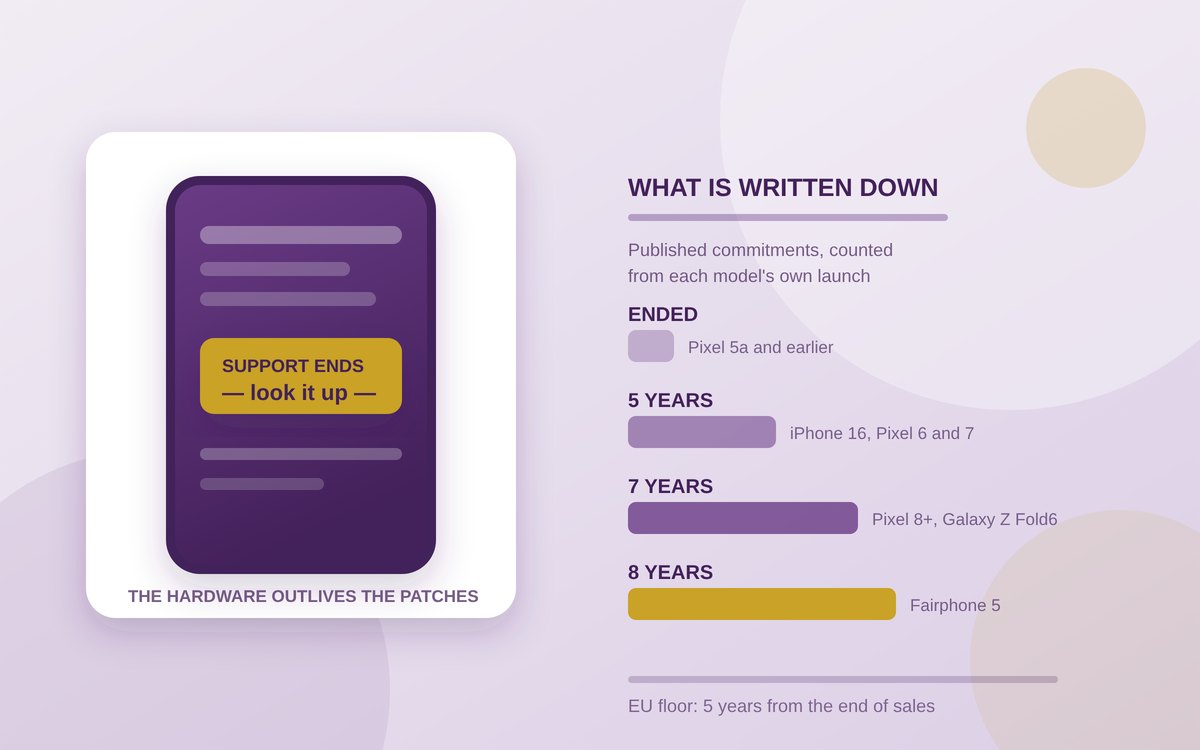
A phone stops being worth owning long before it stops working. What ends first is the software: the month arrives when there is no new security patch, the banking app refuses to launch, and the browser quietly stops receiving fixes for the things browsers get attacked through. The hardware is fine. The support window has closed.
Until recently that date was almost impossible to find out in advance. It has now become findable, because two different regulators decided that manufacturers should have to write it down. Since 20 June 2025, European ecodesign rules have set a legal floor under the support period for phones sold in the EU, and the UK’s product security regime obliges manufacturers to publish a defined support period for connectable products. Between those two documents and the manufacturers’ own support pages, you can now work out roughly when a given handset goes dark.
What nobody states plainly is that those numbers are counted from different starting points. A seven-year promise and a five-year legal minimum can describe the same phone, and the five-year one can be the longer of the two. This guide reads the published documents against each other: the regulation itself, the European Commission’s product pages, and the support and compliance statements issued by Apple, Google, Samsung and Fairphone. There are no tests or measurements of our own here; every figure below is either a requirement in a published rule or a commitment a named manufacturer has put in writing.
On this page
The short answer
For any phone placed on the EU market from 20 June 2025, security and corrective software updates must be available for at least five years — and the clock does not start at launch. It starts on the day the last unit of that model is sold. Manufacturer promises, by contrast, almost always run from the device’s own release date, which means they begin shrinking the moment the phone appears in shops and are well into their second year by the time the model turns up discounted.
So the practical rule is unglamorous: find the model’s release date, add the manufacturer’s stated number of years, and treat the result as the real end date. Then, if the phone is sold in the EU and was placed on the market after June 2025, treat the legal five years from the end of sales as a second floor underneath it. Whichever is later is what you actually get.
Two clocks, two start dates
The regulation’s definition is the part that repays attention. Annex I of Commission Regulation (EU) 2023/1670 defines the “date of end of placement on the market” as the date on which the last unit of a product model is placed on the market. Annex II then requires updates to be available “from the date of end of placement on the market to at least 5 years after that date”.
Read that with a real product cycle in mind. A phone announced in September 2025 and sold until the autumn of 2027 has an end-of-placement date two years after launch, so the legal floor reaches the autumn of 2032 — seven years after it first went on sale. A model quietly discontinued after nine months carries a much shorter effective window. The same rule yields different answers depending on how long the manufacturer kept the thing in the catalogue.
Vendor commitments work the other way around. Google states that Pixel 8 and later devices get seven years of OS and security updates from their US Google Store launch. That is a fixed, knowable end date, and it is the same whether you bought the phone on release day or three years into the run. Buy a two-year-old Pixel and you have bought a five-year phone.
What the EU rules actually require
Regulation (EU) 2023/1670 covers smartphones, other mobile phones, cordless phones and slate tablets, and applies from 20 June 2025. The software provisions in Annex II are more specific than the headline “five years” suggests, and two of the details are the ones worth knowing.
The first is a delivery deadline. Security and corrective updates must reach users at the latest four months after the public release of the source code of the underlying operating system update; functionality updates get six months. That is what stops a manufacturer satisfying the five-year requirement by shipping everything in one enormous bundle on the last day.
The second is a protection against the update that ruins the phone. If a functionality update turns out to have a negative impact on device performance, the manufacturer must restore at least the performance the device had before the update, within a reasonable time and free of charge. Anyone who has watched an older handset slow to a crawl after an upgrade will recognise what that clause is for.
| Requirement | What Annex II specifies | Counted from |
|---|---|---|
| Security and corrective updates | At least 5 years | End of placement on the market |
| Delivery of a security or corrective update | Within 4 months of the OS source code release | Public release of source code |
| Delivery of a functionality update | Within 6 months of the OS source code release | Public release of source code |
| Performance after an update | Prior performance restored, free of charge | — |
| Battery endurance | At least 800 cycles at 80% remaining capacity | — |
| Spare parts availability | At least 7 years | End of placement on the market |
| Spare parts delivery | 5 working days (first 5 years), then 10 working days | Order date |
Note the asymmetry in that table: spare parts outlive the software by two years, so a phone can still be legally repairable once it has stopped receiving security patches. The battery figure is the same one that now appears on the energy label, which we have gone through in our guide to what the EU energy label on a phone box tells you.
Keep reading
What the manufacturers promise
The commitments below are taken from each company’s own published support or compliance documents, not from announcements or press coverage. They are not directly comparable, because they do not all measure the same thing from the same day.
| Maker | Stated commitment | Clock starts | Where it is published |
|---|---|---|---|
| Google (Pixel 8 and later) | 7 years of OS and security updates | US Google Store launch | Pixel update support page |
| Google (Pixel 6, 7, Fold) | 5 years of OS and security updates | US Google Store launch | Pixel update support page |
| Google (Pixel 5a and earlier) | Ended; no further version or security updates | — | Pixel update support page |
| Samsung (Galaxy Z Fold6, Z Flip6) | 7 years of OS upgrades and 7 years of security updates | Not stated on the support note | Samsung support |
| Apple (iPhone 16, model A3287) | Minimum 5 years | First supply date, 20 September 2024 | UK PSTI statement of compliance |
| Fairphone 5 | At least 8 years, with 5 major Android updates | Not stated as a date | Fairphone software longevity page |
Three things stand out. Apple’s figure is the one most people guess wrongly: the company’s own UK compliance statement for the iPhone 16 gives a defined support period of a minimum of five years from a first supply date of 20 September 2024, which is a floor rather than a forecast — historically iPhones have received security updates for longer than that, but five years is what is written down. Google’s page is the most useful of the set, because it names the start date explicitly and publishes the cut-off for every generation, including the models that have already stopped. And Samsung’s note states the length without stating the starting day, which leaves the arithmetic to you.
Fairphone is the outlier worth knowing about even if you would never buy one: its commitment of at least eight years for the Fairphone 5 shows that the ceiling is set by business decisions rather than by silicon.
Advertisement
A security patch is not an upgrade
Almost every dispute about whether a phone is “still supported” comes down to a conflation of two different things. An operating system upgrade moves the device to a new major version and brings new features. A security update patches known vulnerabilities in the version already installed. The regulation treats them separately too, which is why it sets a four-month deadline for the security and corrective kind and six months for the functionality kind.
The security updates are the ones that matter, and a manufacturer can keep issuing them long after the last feature upgrade. A phone two major versions behind but still receiving monthly patches is in far better shape than one that got a shiny new interface last year and nothing since. When a support page gives one number for both, as Google and Samsung now do, the two windows are aligned; when a device is described as getting “three OS upgrades and five years of security updates”, those are two different end dates, and the later one goes on the calendar.
The rest of the new label
The support window did not arrive on its own. Energy labelling for smartphones and slate tablets applies from the same date as the ecodesign rules, and the label carries six pieces of information that between them describe how long a phone is meant to last: an energy efficiency class from A to G, battery endurance per charge cycle, battery endurance expressed in cycles, a drop-resistance class, a repairability class from A to E, and the device’s IP rating.
The repairability class is built from an index of six parameters, and the drop-resistance class grades repeated free-fall reliability from A, the most robust, to E. Neither tells you anything about the software window, but together they answer the question behind it: if this phone is to be patched for most of a decade, will the hardware still be worth patching? The IP rating on the label is also not a promise of waterproofing, a distinction covered in our guide to what IP68 actually protects against.
What actually happens when support ends
Nothing, on the day itself. The phone carries on working, which is exactly what makes the end of support easy to ignore. The consequences accumulate over the following year or two, roughly in this order.
- New vulnerabilities stop being patched. Everything already known about that operating system version stays known, and the phone stays exposed to it. This is the real risk, and it grows rather than appearing all at once.
- The browser falls behind. On Android the browser can keep updating from the app store for a while after the OS stops, but eventually the new version requires a newer system than the phone has.
- Apps begin to drop the version. Banking and payment apps tend to go first, because their own compliance rules push them to require a supported platform.
- Nothing visible breaks. The camera still takes photographs and the phone still makes calls, which is why an unsupported handset is a perfectly reasonable second device, a music player, or a hand-me-down for something that never touches a bank account.
If the phone is being passed on or sold rather than kept, the remaining support window is the single most useful thing to tell the buyer, and it is worth checking before you decide whether the device is worth selling at all — a question we have gone through in our guide to when it is actually worth upgrading your phone.
What to check before you buy
- Look up the release date, not the purchase date. Vendor promises run from launch. A phone that has been on the shelf for eighteen months has eighteen months less support than its advertised number suggests.
- Find the manufacturer’s own page, not a news article. Google publishes per-generation cut-offs; Apple publishes a defined support period in its UK compliance statements; Samsung and Fairphone publish eligibility lists. Those are the documents that bind.
- Check whether one number covers both kinds of update. “Seven years of OS and security updates” is one date. “Three upgrades and five years of patches” is two.
- For a phone sold in the EU, ask when the model stops being sold. That is what starts the five-year legal clock, and a model still in the catalogue has not started it yet.
- Discount the bargain accordingly. A heavily reduced two-year-old flagship is often still the better buy — but it is a four-year phone being sold at a five-year phone’s price, and the arithmetic should reflect that.
- Treat eight years as the current ceiling and five as the floor. Anything below five years on a phone placed on the EU market after June 2025 is worth querying.
The useful change here is not the length of the window but the fact that it is now written down somewhere you can find it. For most of the smartphone era, the honest answer to “how long will this be supported?” was that nobody outside the company knew. The documents that replaced that answer are dull, specific, and worth five minutes before you spend several hundred pounds.
Sources
- Commission Regulation (EU) 2023/1670 — ecodesign requirements for smartphones, mobile phones other than smartphones, cordless phones and slate tablets (Annex II: security and corrective updates available from the date of end of placement on the market to at least 5 years after that date; 4 months after public release of the source code for security and corrective updates and 6 months for functionality updates; restoration of pre-update performance free of charge; at least 800 cycles at 80% remaining capacity; spare parts for at least 7 years with 5 and then 10 working day delivery; Annex I definition of end of placement on the market; applies from 20 June 2025)
- European Commission — smartphones and tablets product page (requirements apply from 20 June 2025; energy labelling applies from the same date; label shows energy efficiency class A to G, battery endurance per cycle and in cycles, drop resistance class, repairability class A to E based on an index of six parameters, and the IP rating)
- Google — About Pixel updates (7 years of OS and security updates for Pixel 8 and later from US Google Store launch; 5 years for Pixel Fold, 7a, 7, 7 Pro, 6a, 6 and 6 Pro; Pixel 5a and earlier no longer receive Android version or security updates)
- Samsung — support note on update eligibility (Galaxy Z Fold6 and Z Flip6 eligible for 7 years of Android OS upgrades and 7 years of security updates; no start date stated)
- Apple — UK PSTI statement of compliance, iPhone 16 (Model A3287) (defined support period of a minimum of 5 years from the first supply date of 20 September 2024)
- Fairphone — software longevity (Fairphone 5 guaranteed software support for at least eight years with five major Android updates; final software update for the Fairphone 3 and 3+ in June 2026)