IP ratings explained: what IP68 actually protects against
Two digits, one standard, and a surprising amount of small print. IP68 is not a depth, it is not a guarantee, and it does not mean your phone has passed every test below it. The useful version of the code takes about ten minutes to learn and saves a repair bill.
There is a particular kind of disappointment that arrives when an IP68 phone stops working after a shower. The owner did nothing reckless; the box said IP68; the phone is, by any reasonable reading of the marketing, waterproof. And yet the warranty claim is refused, and the small print turns out to have said something much narrower than the number implied.
The code itself is not marketing. It comes from a real standard, IEC 60529, which defines degrees of protection provided by enclosures against solid objects and water. What makes IP ratings misleading is not the standard but the gap between what it certifies and what buyers assume: the standard describes one laboratory procedure performed on a new unit, and people read it as a promise about the rest of the device's life. This guide works through the code digit by digit, then sets those definitions against what Apple, Samsung and Google publish themselves. There are no measurements of our own here — everything below is public documentation, linked at the end.
On this page
The short answer
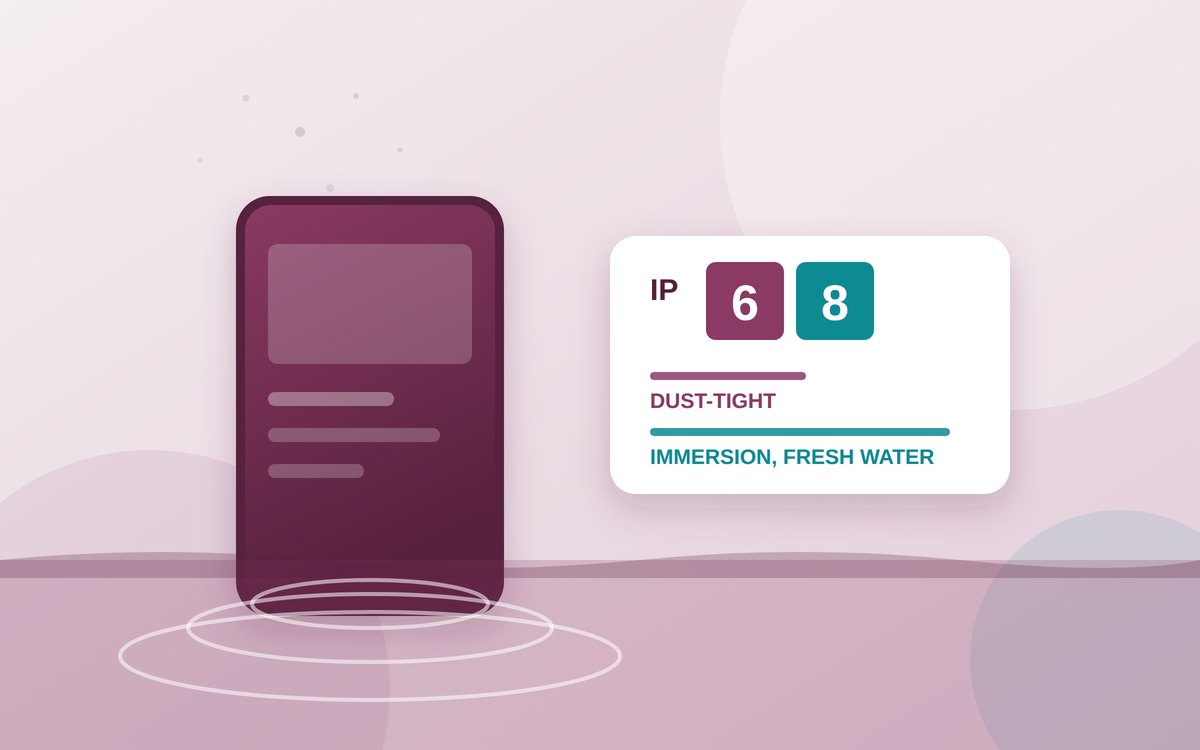
- First digit = solids, second digit = water. IP68 is dust-tight (6) plus continuous
immersion (8). An
Xmeans not rated, not zero. - IP68 is not a depth. Level 8 means immersion deeper than one metre under conditions the manufacturer specifies — which is why Apple publishes 6 metres and Samsung 1.5 metres, both as IP68.
- The water levels are not cumulative. Passing immersion (7 or 8) says nothing about the jet tests (5 or 6), so an IP68 phone is not certified against a shower head — which is why Apple's own advice is to avoid high-velocity water.
- Fresh water only. Salt water, chlorinated pool water, soapy water, sunscreen and alcohol are all outside the rating, and Samsung lists them explicitly as things to avoid.
- It expires quietly. Apple, Samsung and Google all state in writing that resistance is not permanent and degrades with wear, damage and repair; Google adds that liquid damage voids the warranty.
Anatomy of the code
An IP code is the letters IP followed by two digits. The first covers things you can push into
the enclosure — fingers, wires, grit, dust; the second covers water. They are independent scales, and a
device can be excellent at one and untested at the other.
The first digit: solids and dust
The solids scale runs from 0 to 6 and begins as a safety measure rather than a durability one: the lower levels describe whether a person can touch something dangerous inside, level 1 keeping out a body surface the size of the back of a hand and level 2 a finger. Only the top two levels concern dust in the sense consumers mean.
| Digit | Protected against | What it means in practice |
|---|---|---|
| 0 | Nothing | No protection claimed |
| 1 | Objects over 50 mm | Large body surfaces; no deliberate contact protection |
| 2 | Objects over 12.5 mm | Fingers cannot reach live parts |
| 3 | Objects over 2.5 mm | Tools and thick wires |
| 4 | Objects over 1 mm | Most wires and slender screws |
| 5 | Dust-protected | Dust may enter, but not enough to impair operation |
| 6 | Dust-tight | No ingress; dust chamber with vacuum applied |
So the gap between IP65 and IP68 on the solids side is narrow — dust-protected against dust-tight. For anything that shares a pocket with keys and lint, 6 is worth having; the lower levels mostly matter for enclosures, lighting and industrial kit.
The second digit: water
This is where the confusion lives, because the water scale is not one escalating idea but three stacked in a single column: dripping and spraying (1 to 4), pressurised jets (5, 6 and 9), and immersion (7 and 8). Each has its own apparatus and its own pass condition.
| Digit | Exposure | Published test conditions |
|---|---|---|
| 0 | None | No protection claimed |
| 1 | Vertical drips | 10 minutes, equivalent to 1 mm of rainfall per minute |
| 2 | Drips, tilted 15° | Four positions, 2.5 minutes each; 3 mm per minute |
| 3 | Spraying | Spray up to 60° from vertical, 5–10 minutes |
| 4 | Splashing | Water from any direction, around 10 minutes |
| 5 | Water jets | 6.3 mm nozzle, 12.5 litres per minute, from 3 metres |
| 6 | Powerful jets | 12.5 mm nozzle, 100 litres per minute, from 3 metres |
| 7 | Immersion to 1 m | 30 minutes at up to 1 metre |
| 8 | Continuous immersion | Deeper than 1 metre, to a depth and duration the maker states |
| 9 | High-pressure, high-temperature jets | 80–100 bar at around 80 °C |
Note what level 8 does not fix: a depth. The standard leaves depth and duration to the manufacturer, which is why two phones can both be IP68 while one is specified to 1.5 metres and the other to 6. The code is a category; the figure that matters sits in the support document, not on the box.
Why a bigger number is not always better
Here is the most useful thing in this guide: the water levels are not cumulative above level
6. A device certified to IPX7 or IPX8 has not, by that certification, demonstrated anything about jets.
The immersion test is a still tank; the jet tests are a nozzle under pressure. A device that has passed both is
written with slash notation — IPX5/IPX7 — precisely because one code cannot express both.
That explains a line in Apple's guidance that otherwise reads as excessive caution. Apple tells iPhone owners not to swim or bathe with the phone, not to expose it to pressurised or high-velocity water, and to stay out of saunas. It is not hedging: a shower is a jet, not an immersion, and an IP68 iPhone has not been certified against one.
The same logic applies to the X. IPX4 on earbuds does not mean they scored zero
for dust; it means dust was never submitted for testing — usually a cost decision rather than a
confession, but silence is not a pass.
Keep reading
Why IP68 phones claim different depths
Because level 8 defers the depth to the manufacturer, published figures vary widely across devices wearing the same code. Apple alone lists its IP68 iPhones in three bands.
| Device | Code | Manufacturer's stated conditions |
|---|---|---|
| iPhone 12 through iPhone 17 series, iPhone Air, 16e, 17e | IP68 | Up to 6 metres for up to 30 minutes |
| iPhone 11 Pro and 11 Pro Max | IP68 | Up to 4 metres for up to 30 minutes |
| iPhone 11, XS and XS Max | IP68 | Up to 2 metres for up to 30 minutes |
| iPhone SE (2nd and 3rd gen), XR, X, 8, 7 | IP67 | Up to 1 metre for up to 30 minutes |
| Samsung Galaxy phones rated IP68 | IP68 | 1.5 metres of fresh water for 30 minutes, held still |
| Google Pixel 10 series | IP68 | Rated to IEC 60529 “when it leaves the factory” |
Two details deserve underlining. Samsung specifies the device was submerged without any movement: moving through water adds pressure the test never applies, which is why swimming is excluded even by makers whose phones survive a sink. And Google attaches the rating to the factory gate rather than to the device, which is the most honest framing any of them use.
Advertisement
What the manufacturers actually say
Read the support pages side by side and a consistent position emerges, narrower than the number on the box.
Fresh water only. Samsung is the most explicit: do not expose the phone to salt water, pool water, soapy water, oils, perfumes, sunscreen, hand sanitiser, cosmetics or anything containing alcohol. Chlorine and salt attack seals and adhesives, and soap lowers surface tension so water creeps into gaps it would otherwise bridge. None of those liquids appears anywhere in the test procedure.
Dry it before charging. Samsung warns that connecting a charger before the port is completely dry may damage the device — which is why phones show a moisture warning instead of charging. Waiting it out is cheaper than overriding it.
Liquid damage is not a warranty matter. Apple states that liquid damage is not covered under warranty, while noting that consumer law may give you separate rights; Google's safety guide is blunter, saying liquid damage voids the warranty. An IP rating is a design specification, not an insurance policy.
The rating has a shelf life
Every manufacturer quoted here says a version of the same sentence. Apple: splash, water and dust resistance are not permanent conditions, and resistance might decrease as a result of normal wear. Samsung: the water resistance of Galaxy phones is not permanent and may be weakened over time or through natural wear and tear. Google is the most specific, naming the causes — wear and tear, device repair, disassembly or damage — and adding that dropping the device may itself cost you the rating.
Mechanically this is unsurprising. The seal is a gasket and a line of adhesive, both of which take a set and lose compliance; membranes clog; a cracked back panel breaks the seal completely even while the phone still works. A repair is the biggest single step down, because resealing to factory specification needs the right adhesive correctly seated, and most repairs are never re-tested.
The buying consequence is concrete: a second-hand phone advertised as IP68 is advertising a property it had when new, and if it has been opened the seal is a question mark — worth asking about when you work through what a refurbisher's grade covers, since cosmetic grades describe the outside of the case, not the gasket behind it.
IP on the EU energy label
Since 20 June 2025 new smartphones and tablets placed on the EU market carry an energy label, and the IP class is one of the things shown on it, alongside a drop-resistance class and battery endurance. That is a real gain in transparency — the rating moves from a line in a support document to a standardised pictogram at the point of sale — but it does not change what the code certifies: a label reading IP68 still describes a test on a new unit in fresh, still water. We cover the rest of that label in our guide to what the new phone energy grades mean.
What rating do you actually need?
Most people over-buy on this specification and then rely on it in exactly the situations it excludes. Match the rating to the water you will actually meet instead.
| What you are worried about | Rating worth having | Why |
|---|---|---|
| Sweat and light rain on earbuds | IPX4 | Splashing from any direction is the relevant test; dust is rarely rated on earbuds |
| A phone in rain, or dropped in the sink | IP67 or IP68 | Both cover brief immersion; the difference is depth, not survival odds |
| A speaker by the pool or in the garden | IP67 plus IPX5 or IPX6 | Splashes and jets, not depth; look for slash notation |
| A torch or camera used in heavy spray | IP65 or IP66 | Jets are the correct test; immersion ratings say nothing about them |
| Deliberate swimming or diving | No IP code is sufficient alone | Movement adds pressure the tests never apply; look for an explicit activity claim |
Four habits do more good than any upgrade in rating. Dry the port and wait before charging. Keep the phone out of pools, the sea and the shower, all three outside the certificate. Treat a cracked back or a repaired phone as unrated. And if something does go in, resist switching it on to check: makers advise against powering up a device that may have taken water.
The code is genuinely useful once read as what it is — a standardised description of two laboratory tests, performed once, on a new device, in clean still water. That is worth comparing. It is simply not the sentence “this device is waterproof”, and nobody who publishes it has claimed that it was.
Sources
- IEC — Ingress Protection (IP) ratings, the body that publishes IEC 60529
- TÜV SÜD — Ingress protection testing to IEC 60529 (scope of the standard, meaning of the digits, test chamber limits per level)
- Keystone Compliance — IEC 60529 IP code certification testing (published test apparatus and durations by level)
- Keystone Compliance — IPX7 and IPX8 water immersion testing (immersion depth and duration; IPX8 conditions set by the manufacturer)
- IP code — consolidated table of IEC 60529 levels, including the non-cumulative rule above level 6 and slash notation
- Apple Support — splash, water and dust resistance of iPhone 7 and later (IP67/IP68 by model, depths and durations, activities to avoid, warranty position on liquid damage)
- Samsung UK Support — Galaxy phone water resistance (1.5 m fresh water for 30 minutes held still; prohibited liquids; drying before charging; resistance not permanent)
- Google — safety and regulatory guide for Pixel 10 (IP68 to IEC 60529 at the factory; resistance diminished by wear, repair, disassembly or damage; liquid damage voids the warranty)
- European Commission — ecodesign and energy labelling for smartphones and tablets, applicable from 20 June 2025
- Fraunhofer IZM — the EU energy label for mobile devices (IP class shown on the label alongside drop resistance and battery endurance)