The EU common charger rules: what they actually require
Everybody remembers the headline: new phones sold in the EU must have a USB-C port. That is one sentence out of four separate obligations, and it is the least useful of them. The other three govern charging speed, what the box must tell you, and whether you are allowed to buy the device on its own.
Directive (EU) 2022/2380 is short, dull and unusually specific, which is exactly why it is worth reading rather than remembering. It amends the Radio Equipment Directive and inserts an annex — Annex Ia — that lists, in plain numbers, what a manufacturer must do before it can sell a phone, a pair of earbuds or a laptop in the European Union. Most of the reporting since 2022 has compressed all of that into “the EU made everyone use USB-C”.
The compression matters, because the parts that went missing are the parts you can actually use in a shop. The directive obliges a manufacturer to print the wattage its device needs. It obliges fast charging to work with any compliant charger rather than only the branded one. And it obliges the seller to offer you the same device without a charger in the box, which is a right rather than a default. None of that is visible if you only know about the socket.
What follows is a reading of the published legal texts and the European Commission's own guidance pages. There are no measurements of our own here, and nothing has been tested in a laboratory: every figure below comes from a directive, a regulation or an official explanatory page, each linked at the end.
On this page
Which devices, and from when
The obligations attach to categories of product, not to brands, and they attach only to devices that can be recharged by wire. A set of wireless-only earbuds with no charging socket at all falls outside the receptacle requirement entirely, because there is no port to standardise.
Two dates matter. From 28 December 2024 the rules apply to handheld mobile phones, tablets, digital cameras, headphones, headsets, earbuds, portable speakers, handheld videogame consoles, e-readers, keyboards, mice and portable navigation systems. From 28 April 2026 they apply to laptops as well, which is why the current generation of Windows machines quietly abandoned barrel connectors.
Both dates bite on placing on the market, not on selling to you. Stock that legally entered the market before the relevant date is unaffected and may continue to be sold, which is why an older model with a different connector can still appear on a shelf without anybody breaking the law.
The four obligations
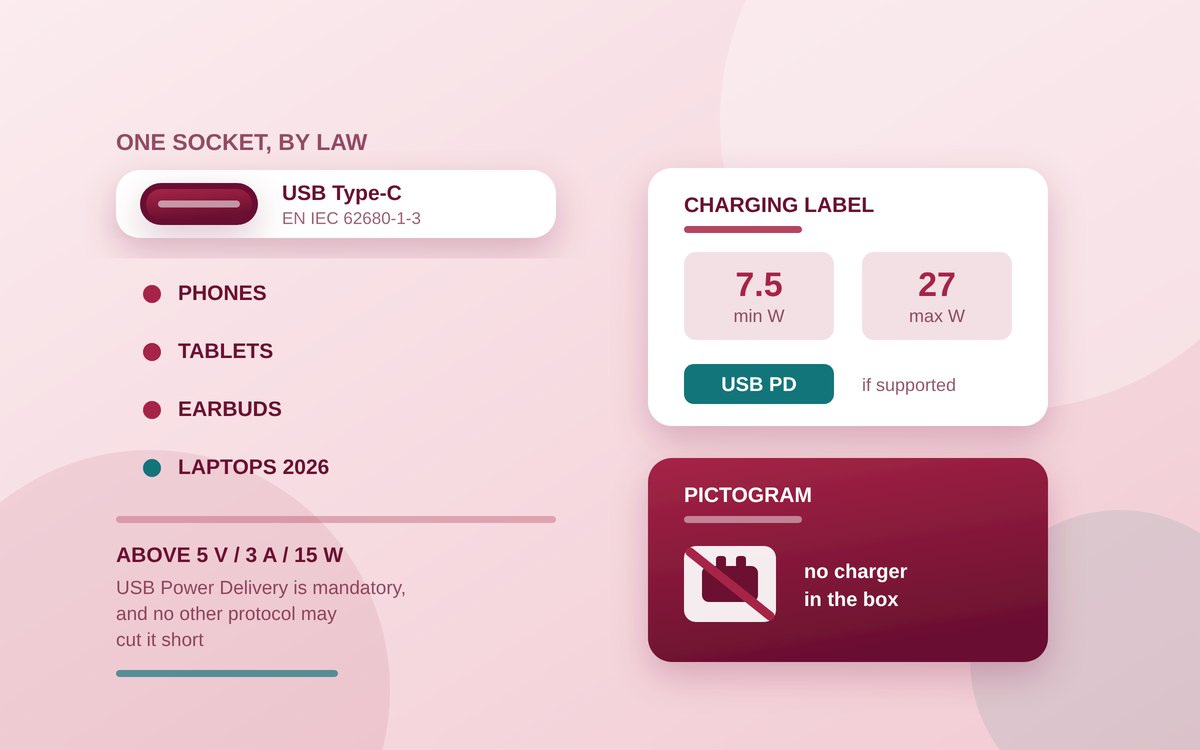
Annex Ia splits into parts, and each part does a different job. Part I is the hardware requirement: a covered device capable of wired charging must “be equipped with the USB Type-C receptacle, as described in the standard EN IEC 62680-1-3:2021”, and that receptacle must “remain accessible and operational at all times”. The second half of that sentence is doing real work: it forecloses the obvious workaround of fitting a compliant port and then burying it behind a proprietary dock or a magnetic cover.
The same part requires the device to be chargeable with cables built to the same standard, which closes the other obvious gap — a port that only accepts one vendor's cable.
| Obligation | Where it sits | What it means at the counter |
|---|---|---|
| USB Type-C receptacle, always accessible | Annex Ia, Part I | Any USB-C cable fits, on any covered device |
| USB Power Delivery above 5 V, 3 A or 15 W | Annex Ia, Part I, point 3.1 | Fast charging is not reserved for the vendor's own brick |
| Printed charging information and label | Annex Ia, Parts II and IV | The minimum and maximum wattage are on the box |
| Option to buy without a charging device | Article 3a(1) | You may decline the brick; the pictogram says whether one is included |
The fast-charging clause nobody mentions
This is the provision worth knowing. Point 3.1 of Annex Ia says that where a device can be charged at voltages above 5 V, currents above 3 A or powers above 15 W — any one of the three is enough to trigger it — the device must “incorporate the USB Power Delivery, as described in the standard EN IEC 62680-1-2:2021”.
Point 3.2 then closes the door behind it. A manufacturer may still implement its own charging protocol, but any such protocol must “allow for the full functionality of the USB Power Delivery referred to in point 3.1”, whichever charger is used. In other words, a phone may ship with a proprietary turbo mode, but it is no longer permitted to fall back to a crawl when you plug in somebody else's standard charger.
That has a practical consequence for anyone who has bought a well-reviewed third-party charger and found it delivering a fraction of its rating. On a covered device sold after the relevant date, the shortfall is now far more likely to sit in the cable, the device's own ceiling or the negotiation between them than in deliberate vendor lock-out — which is the subject of our guide to why your phone will not charge at the number printed on the charger.
Keep reading
The label on the box
Part II requires the manufacturer to describe the power requirements of compatible chargers, including the minimum and the maximum. Part IV turns that into a printed label with two figures: the first is the minimum power the device needs in order to charge at all, and the second is the power needed to reach its maximum charging speed. Where the device supports USB Power Delivery, the letters USB PD appear on the label too. Part III adds a separate pictogram, in two versions, showing whether a charger is or is not included in the box. Both marks have to stay visible and legible, and the directive even specifies a minimum size: dimension “a” must be at least 7 mm.
Two numbers and three letters do not sound like much. In practice they settle the question that drives most charger purchases. If the label says the device reaches full speed at 27 W, a 100 W charger buys you nothing on that device; if it says 7.5 W minimum, the ancient brick in the drawer will charge it, slowly. The information was always buried in a support page somewhere. The directive moved it onto the packaging.
Advertisement
What the rules deliberately do not do
A standardised connector is not a standardised port, and the directive is careful not to pretend otherwise. The socket on a compliant phone may still be a 480 Mb/s USB 2.0 port; nothing in Annex Ia touches data rates, video output or peripheral support. That is a separate stack of specifications, covered in our guide to what a USB-C port actually promises.
Wireless charging is outside the scope too. The receptacle requirement applies to devices “capable of being recharged via wired charging”, and says nothing about charging pads, magnet profiles or coil alignment — the ground covered by the Wireless Power Consortium's own standard rather than by EU law.
Cables are the most interesting omission. The unbundling obligation covers the charging device, not the cable, so a box with no brick may still contain a lead. The Commission noticed: Article 47(3), as inserted by the directive, requires a report to the Parliament and the Council by 28 December 2026 on the impact of buying equipment without a charging device and without cables. Recital 10 is blunter still, saying the Commission should consider extending the requirement to cables. Whatever lands, it will not land before that report.
| Common belief | What the directive actually says |
|---|---|
| “Every device must have USB-C” | Only listed categories, and only those that charge by wire |
| “Chargers are banned from the box” | You must be offered the device without one; including one stays legal |
| “Any charger now charges at full speed” | True only above the 5 V / 3 A / 15 W threshold, where USB PD is mandatory |
| “USB-C means fast data” | Data rates are untouched; 480 Mb/s is still compliant |
| “It caps charging at 100 W” | No ceiling in Annex Ia; 100 W appears only in a recital, as an illustration |
| “Old models are illegal now” | Stock placed on the market before the date may still be sold |
2028: the rules come for the charger itself
Directive 2022/2380 regulates the device. The thing on the end of the cable is governed separately, and that half of the picture changed in October 2025 with Commission Regulation (EU) 2025/2052 on the ecodesign of external power supplies. It repeals the earlier Regulation (EU) 2019/1782 and applies from 14 December 2028.
Its scope is wider than the directive's: external power supplies, chargers for portable batteries of general use, wireless chargers and charging pads, and USB Type-C cables. The headline requirement mirrors the device side — power supplies are to carry at least one USB Type-C or USB Power Delivery port, with exemptions for products such as electric toothbrush and vacuum cleaner supplies. A common charger may not have a hard-wired USB-C cable, which is what makes a single brick genuinely reusable. And USB Type-C cables must be marked at the plug with their power rating, either 60 W or 240 W: a small change that removes the single most common cause of a charger underperforming.
The Commission's own estimates for the measure are worth repeating with their source attached, because they are projections rather than observations: more than 400 million external power supplies are sold in the EU each year, and by 2035 it expects annual savings of roughly 3 per cent of their lifecycle energy use and a fall in consumer spending of around €100 million a year. For the device-side rules, the Commission estimates 980 tonnes less electronic waste a year and at least €250 million saved on unnecessary charger purchases.
Great Britain, Northern Ireland and the gap between them
For readers in the United Kingdom the answer is genuinely split. The requirements were implemented in Northern Ireland by the Radio Equipment (Amendment) (Northern Ireland) Regulations 2024, with the same two dates: 28 December 2024 for the main categories and 28 April 2026 for laptops. Equipment placed on the market before those dates is unaffected.
Great Britain has no equivalent requirement in force. The Government's published guidance notes that industry has told it they are “highly likely to adopt similar measures for devices supplied to the whole of the UK”, and it has sought views to help assess introducing similar measures UK-wide. That is the honest state of play: no GB obligation, a strong commercial expectation that manufacturers will not build a separate GB variant, and qualifying Northern Ireland goods that meet the requirements may in any case be sold in the rest of the UK.
The practical reading for a British buyer is that the label and the unbundling option are a commercial choice rather than a legal right, so a device sold in Great Britain may legitimately arrive without the printed wattage figures. In practice most manufacturers print one label for Europe and ship it everywhere.
What to check in the shop
- Read the two numbers before buying a charger. The maximum figure on the label is the point beyond which extra watts do nothing for that device.
- Look for the pictogram, not the price. It tells you whether a brick is in the box, which is the difference between two apparently identical listings.
- Ask for the version without a charger. Sellers must offer it. If a shop only lists the bundled version, the unbundled one usually exists on the manufacturer's own store.
- Check whether a cable is included separately. Unbundling does not cover cables, and the box may contain one, both or neither.
- Do not read the port as a data spec. A compliant USB-C socket can still be USB 2.0.
- Treat Great Britain as unlabelled territory. The information may be there, but nothing requires it, so fall back on the manufacturer's specification page.
- Keep the good brick. Once the device side is standardised, one competent multi-port USB PD charger covers almost everything you own — which is the entire point of the exercise.
The common charger rules are an unusually honest piece of regulation: narrow, dated, and explicit about what they have left for later. The socket was the easy part and it is finished. The interesting half — cables, and the brick itself — arrives on a timetable that now runs to 2028, and the next marker to watch is the Commission's cable report at the end of 2026.
Sources
- EUR-Lex — Directive (EU) 2022/2380 (Annex Ia Part I: USB Type-C receptacle per EN IEC 62680-1-3:2021, accessible and operational at all times; point 3.1 USB Power Delivery above 5 V, 3 A or 15 W; point 3.2 other protocols must allow full USB PD functionality; Parts II to IV on information, pictogram and charging label; Article 3a(1) on offering the device without a charging device; Article 47(3) report by 28 December 2026)
- European Commission — One common charging solution for all (covered categories; 28 December 2024 and 28 April 2026 dates; estimates of 980 tonnes of electronic waste and at least €250 million saved a year)
- European Commission — Regulation (EU) 2025/2052 on external power supplies (scope including wireless chargers and USB Type-C cables; at least one USB Type-C or USB PD port; no hard-wired USB-C cable on a common charger; 60 W and 240 W cable plug marking; application from 14 December 2028; repeal of Regulation (EU) 2019/1782; 400 million units a year and the 2035 savings projections)
- EUR-Lex — Commission Regulation (EU) 2025/2052 of 13 October 2025, full text
- UK Government — Radio Equipment (Amendment) (Northern Ireland) Regulations 2024 guidance (implementation in Northern Ireland; the same two dates; equipment placed on the market before them unaffected; industry “highly likely to adopt similar measures” UK-wide; qualifying Northern Ireland goods may be sold in the rest of the UK)